Sam Martin's Historical Gleanings refers to Paddy
Cushy Glen – a noted robber who lived at the Back
Strand, afterwards removed to the Murderer's Hole on
the road between Limavady and Coleraine. He had a
brother called James Cushy Glen who was executed in
Derry for stealing 3 bullocks, who were the property
of Mr Hughy.
There is a tale that James may have
been walked in chains from Limavady to Derry to be
hanged.
Memoirs of the Coleraine Knoxes
written down by R Kyle-Knox: (unpublished papers)
'That night two masked men called on
my great-grandfather at his house. They told him he
must come and visit a dying man but he must consent
to be blindfolded. After some hesitation he agreed
to their terms and went with them. He was absent
three days leaving his family in greatest
consternation. On his return he was brought back
blindfolded as before. He never knew himself where
he had been, but he told them he had spent the time
at the bedside of the highwayman Cushy Glen and had
closed his eyes after his death.'
Pat
Cushy Glenn - sources Londonderry Journal -21 March
1780 and 24 April 1781
The Derry Journal,
previously the 'Londonderry Journal and Donegal
and Tyrone Advertiser' is one of Ireland's oldest
newspapers having been established in 1772. In its
pages are documented the life of Derry and its
hinterland from the late 18th century. The
following advertisement appeared in the Journal
dated 21 March 1780:
'Joseph
Smith and Pat Glenn accused of being accessories
to the murder of John Kelly late of Aughill,
Tamlaghtard (Magilligan) will surrender
ourselves to the next Assizes'.
However, it appears that Pat Glenn
failed to turn himself in and went on the run, as
revealed in a subsequent advertisement dated 24
April 1781.
'John
Church
(and others who are not named) of Coleraine
offer a reward for the apprehension of Robert
Jack, Bernard Dogherty, John McCoy, James
Miskimmen, Bryan McNogher and Patrick Cushaglen,
who are accused of murdering John Kelly in the
parish of Magilligan'.
Here we have Pat Glenn and Patrick
Cushaglen used interchangeably in a contemporary
source, thus adding substance to the oral history.
In the Belfast Newsletter,
(online database) a similar advertisement with
additional names appeared in the edition dated 29
May – 1 June 1781. John Church of Coleraine was
offering reward for the apprehension of the
following men for the murder of John Kelly of the
parish of Magilligan – Robert Dougherty, Bernard
Dougherty, Jack Dougherty, John McCoy, James
Maskimman, John Maskimman, Bryan McNagher and
Patrick Cushyglen. Mention was made of 'daring
violent outrages'.
Bernard Dogherty was subsequently
apprehended and imprisoned but escaped, as noted in
the Derry Journal of 12 March 1782.
'reward
offered by Michael Ross, William Lenox,
Sheriffs, for the apprehension of the following
who escaped March 5 from Londonderry jail –
Bernard Dogherty, shoemaker charged with murder,
formerly resided at Newtownlimavady aged about
35 years . . .'
Patrick Cushy Glenn remained at large
until he was shot by James Hopkins at the Murder
Hole Road some years later.
The
Murder Hole and the Ram's Horn
Tradition has it that Cushy Glenn
held up the Coleraine stagecoach near Sconce Hill,
robbed and murdered the passengers and dumped their
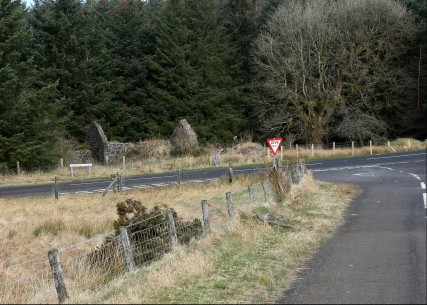
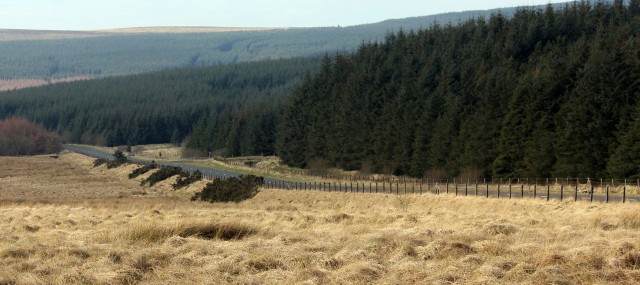
bodies in a hole near the old coach road. This road
was then known locally as the Murderhole Road. The
road officially became Windyhill Road in the 1970's.

Several tales about Cushy Glenn
revolve around a small house on that road near the
junction with Bolea Road. It was occupied until
about 50 years ago by Gilbert Purcell, a shepherd
with Grange Park and had two magnificent ram's horns
– one on each gatepost. Stories tell of the house
having been Cushy's home, a roadside inn, a hotel
and various other fanciful things. Some local people
(of normally great common sense) are convinced they
have 'seen things' in the vicinity of the house.
Incidentally, the area is very isolated, surrounded
by shadows and trees, through which the Windyhill
wind moans and whistles – and that's on a bright
sunny day.
Cushy's
wife
Many tales refer to Cushy Glenn's
wife aiding and abetting him in his dastardly deeds
– helping him to bury the bodies, encouraging him
with wifely inquiries such as 'Did you get him
Cushy?' and generally being a real bad lot.
However, it appears that she did
exist and remarried some time in 1807. In the
marriages section of Belfast Newsletter dated 11
December 1807 are the following thought-provoking
entries:
-MARRIED-
At Newtonlimavady,
Miss Mullin, of Scrugan, near Dungiven, to Mr.
Samuel Birnie, late merchant, Newtonlimavady
Mrs. Cushie Glen,
widow of the late Mr. Patrick Cushie Glen, of
the Murder-hole, to Mr. Wm. Lecky, nailer,
Newtonlimavady.
A few days ago, Mr.
Robert Glen, of Ballyfrench, to Miss Miller, of
Ballyhalbert.
On Monday last, Mr.
John Logan, of Centry-hill, near Castlereagh, to
the agreeable Miss Ann Richardson, of Ballytrim,
near Killileagh.
An interesting twist
in the wife tale, is that Cushy Glenn and his
brother 'lived with a woman and a whole bake of
wains' up the mountain somewhere. The brother was
hanged for stealing bullocks and Cushy was shot by
a local farmer. A Presbyterian minister was called
to treat Cushy for his wounds and somehow in the
tale, the minister's wife took pity on the 'poor
wains', bringing them food and eventually taking
one of the girls to work in her house. The girl
grew up honest and hardworking and changed her
name to be rid of her beginnings. Probably married
a prince, too.

This impressive sculpture of Cushy
Glen was installed in 2013 by Limavady Borough
Council at Largantea picnic area as part of their
Sculpture Trail of myths and legends. The
robber is shown behind the bank at the side of
Windyhill Road, lurking malevolently, knife in hand,
awaiting his next victim.
The work is by the well-known Derry
sculptor, Maurice Harron.
For
the written facts and many of the references
quoted I am indebted to Mr Bobby Forrest and Dr
Hugh Mullin, both of whom were most helpful in
supplying papers and pointers to information.
Other anecdotes have been supplied by my mother's
family who used to live in the Bolea and
Stradreagh areas and from relatives of other
families from these two townlands.
Sources:
- Ordnance Survey Memoirs of
Ireland (written down in 1834 from verbal
accounts of the areas surveyed)
- Genealogical extracts from the
Londonderry Journal 1772-1784: Donald M
Schlegel, Baltimore 2001 (reprint – Genealogical
Publishing Company)
- Belfast Newsletter Index,
1737-1800 online at
http://www.ucs.louisiana.edu/bnl/
Further reading:
- Dr Mullin's papers are
available to view in Coleraine Library
- Who Shot Cushy Glenn? by
Jacqueline McAlister – Journal of Coleraine
Historical Society 2000
Stories
of Highwaymen in Irish history and folklore:
- An Illustrated History of
Limavady and the Roe Valley by Douglas Bartlett
- The Irish Highwaymen by Stephen
Dunford
- From Glen to Glen (Roe Valley
Tales Re-told) by Mary Ellen Hayward
- Stand and Deliver - Stories of
Irish Highwaymen by Jim McCallen
---o0o---
And finally here is a link to Margaret's own website
of oil
paintings.