Dungiven Priory
and
Bawn
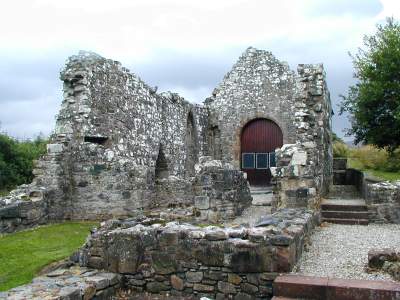
The ruins of the priory in Dungiven Grid Treference C69420844
|
The ruins of the priory in Dungiven Grid Treference C69420844 |
|
Considering how important this place must have once
been for the
area, it is
surprising how little is known about Dungiven Priory. It is thought
possible that there was a pre-Norman monastery here by 700 AD, but not
much more is known about this. We do know
however, that there was an Augustinian monastery on
the site by 1200 AD. Tradition has it that it was founded by the
O'Cahans though even this is doubtful. In the 13th century the chancel
was added to the building. It is known that in 1397 the archbishop of Armagh visited Dungiven to re-consecrate the church. Apparently a blood-crime had been committed here - we have no more detail of the deed.  For a while the place was famous for teaching, and students came from as far away as Scotland and France. In those days only the offspring of rich and important people received an eduction, which in this priory did not just involve academic subjects but also training in the use of weapons . Possibly this explains the bloody deed above - who knows? The monks gave up in the second half of the 16th century and shortly after that the O'Cahans used the place as a stronghold. They no doubt made use of the four storey square tower house which had been added to the complex sometime during the 15th century. This tower collapsed in 1784. The O'Cahans lost the war against the English and in 1603 the site was confiscated by Sir Edward Doddington, an English soldier. He built himself a manor house and bawn which has only been partly uncovered. Sir Edward became the chief tenant of the Skinners company who owned Dungiven and surrounds during the plantation period. The site fell out of use sometime towards the end of the 17th century, though the surrounding graveyard was still utilised - slowly burying the ruins of the other buildings. Most of the place was excavated in 1982. Shortly afterwards it was decided to put a roof on the chancel, in order to keep the damaging rain off O'Cahan's tomb - one of the most unique grave monuments in Northern Ireland. Link to O'Cahan's tomb |
|
Return
to history
page
|
Back to the start

|
Continue with next
page
|

